Cine Renoir en Roanne
Cine Renoir en Roanne
REMAKE studio renovates the historic Renoir Cinema in Roanne, France, through a low-budget intervention that reconfigures the access, incorporates a new transparent facade and reuses existing materials to expand its cultural program.
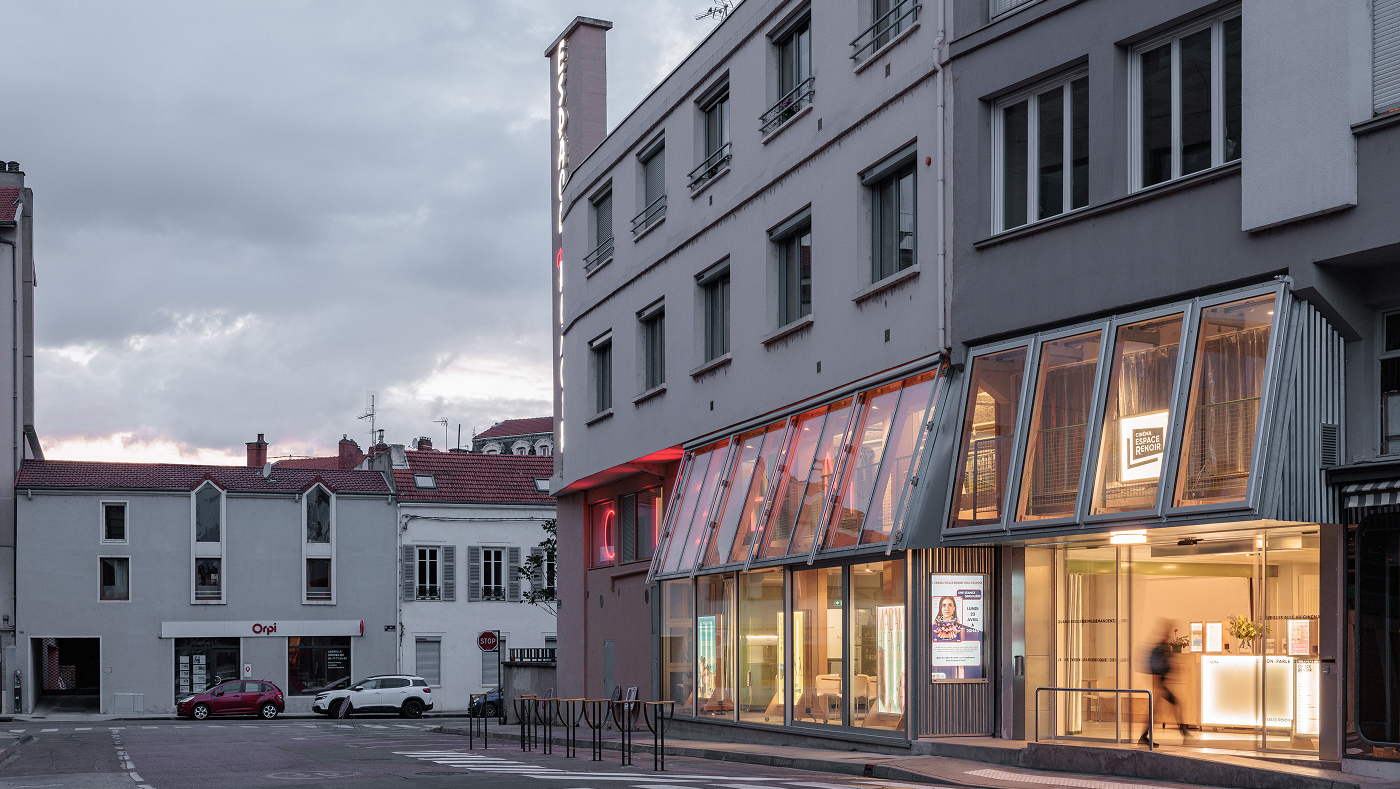
The Renoir Cinema occupies a prominent place in the cultural life of Roanne, a small city of forty thousand inhabitants located in the Loire department. Founded in the 1950s as an independent cinema, it has been managed by the Ciné Rivage association since 1988. With two screening rooms seating three hundred and one hundred and thirty seats, it is the city's only art-house cinema and one of its few independent cultural spaces.
In 2019, faced with increasing competition from digital platforms and a declining audience, Ciné Rivage acquired the commercial space adjacent to the cinema lobby. The goal was to improve the reception area, expand the cultural offerings, and refresh the establishment's public image. Through a competition that concluded at the end of 2021, the REMAKE studio was selected to carry out the renovation project.


Built in 1969, the building evokes the aesthetic of early sound cinemas. Its occupation of the western triangle of the plot—extremely acute, with an angle of 14 degrees—results in very narrow interior spaces. On the upper floors, two apartments with a single orientation occupy the floor plan, with depths ranging from 0.8 to 4.7 meters.
Why build on such a narrow plot within a low-density urban environment? The investigation reveals that both the prow-shaped building and the volume that now houses the entrance were erected by the same owner—the cinema owner—after the opening of Rue Jean Puy. His sole purpose was to create a facade for the cinema, with signage visible from two key public spaces.


The project seeks to restore a narrative that never fully materialized: to give the cinema the facade it was originally intended to have. To achieve this, it was necessary to create continuity between the column supporting the cinema sign and its entrance, a route previously interrupted by two blocked windows, the residential staircase, and the café.
The program design for the new space was deliberately open, and the interior was kept as flexible as possible. The façade, suspended from the concrete structure, introduces no load-bearing support points on the already fitted-out ground floor. Thus, the renovated space can accommodate a variety of uses: a café, headphone screenings, editing workshops, debates, concerts, parties, and more.

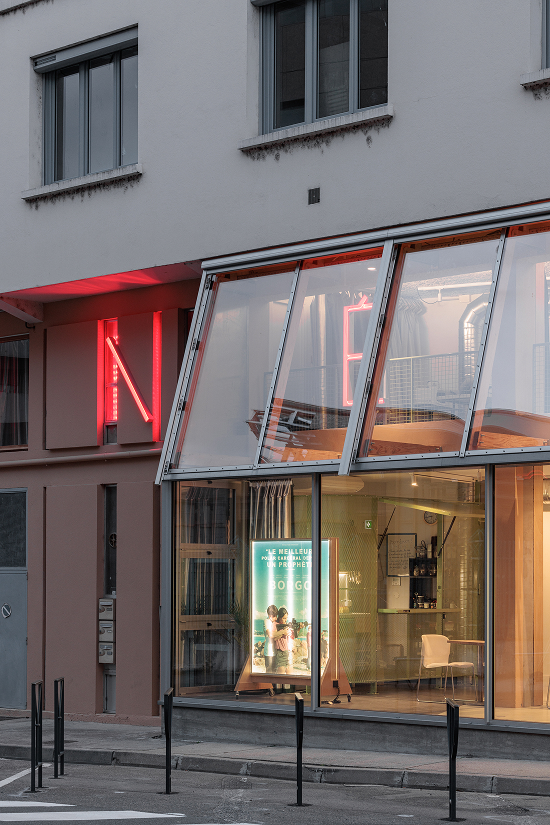
The project seeks to intertwine the intervention on the existing building with the expression of the cinema's renovation. The new, highly transparent façade reveals the continuity of the concrete structure from the street while simultaneously asserting its own distinct identity.
A construction budget calculated solely on the surface area of the former café quickly led to a radical cost-cutting strategy. Lightweight devices, such as curtains and metal screens, allowed the project's scope to be expanded without additional cost. Much of the existing surfaces were preserved, with all their marks and signs of use.
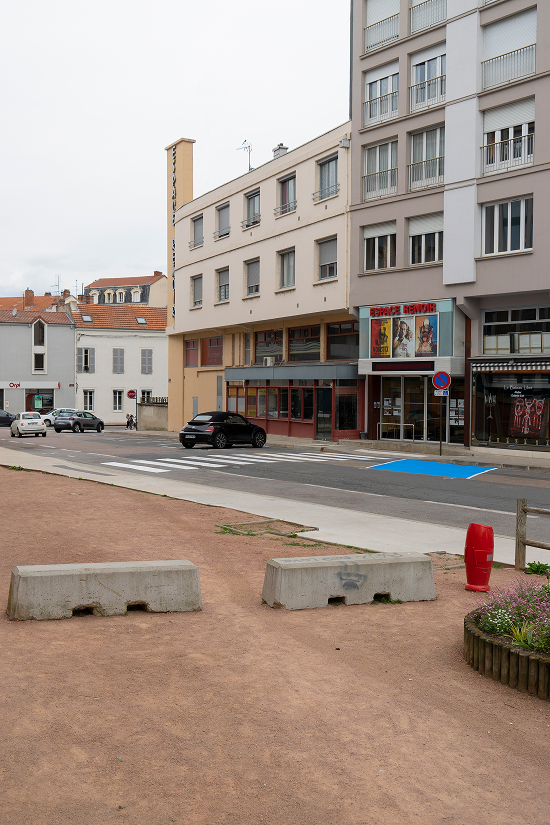

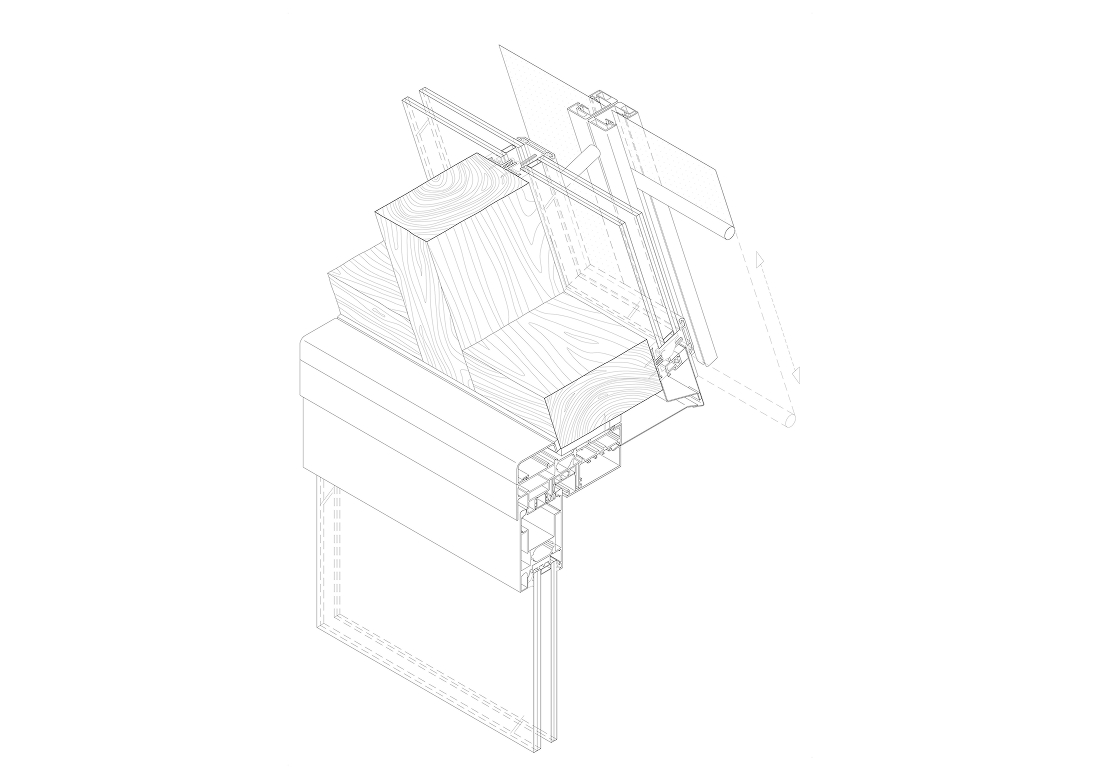
The reuse of existing elements became the driving force of the project. The wood from an old mezzanine was sorted, planed, reassembled, and reinstalled, forming two-thirds of the new facade's timber structure. The plywood panels that previously covered the cinema's corridor were removed and reused to make furniture and signage.
To address the uncertainty surrounding future uses of the space, the ground floor allows for the reconfiguration of all furniture and signage elements.
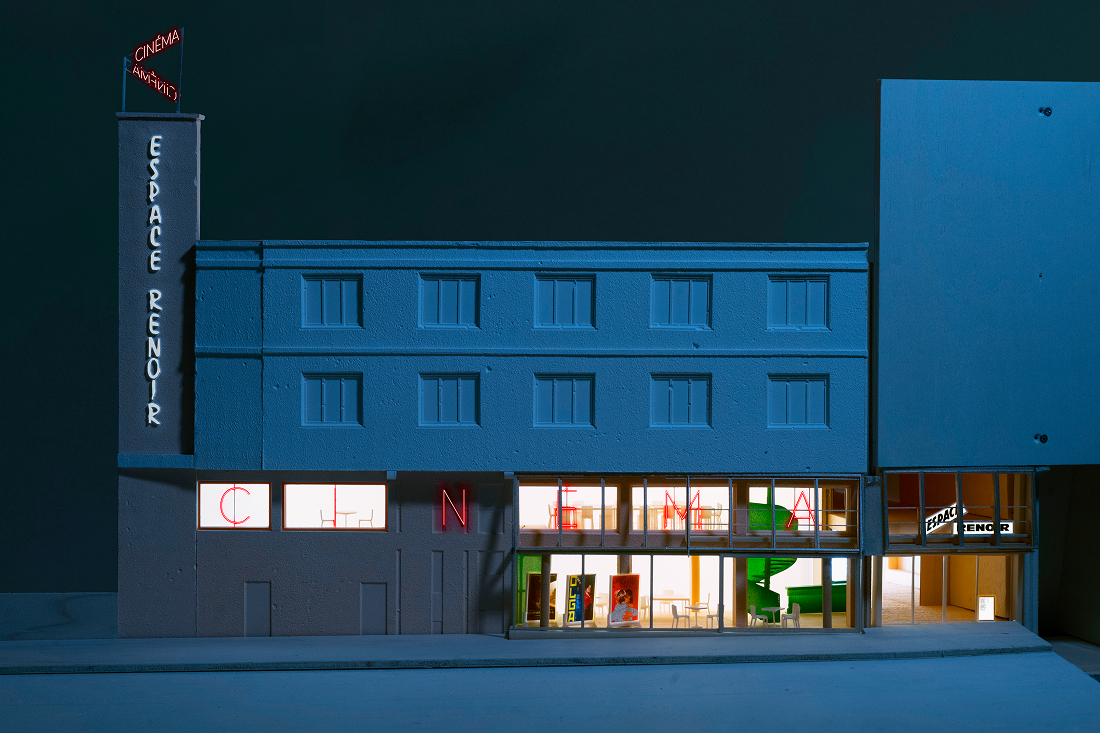
The decision to minimize the use of high-carbon-footprint materials led to a hybrid construction approach. The timber structures are clad with a thin layer of steel and glass, providing the necessary robustness for an envelope in direct contact with the public space and the elements. A simple system of stainless steel clamps secures the glass panels to the timber frame.
The new façade functions as a passive thermal system to ventilate this south-facing, single-aspect space. In winter, the transparent glazing allows for solar gain. In summer, an exterior sunshade protects the former café area. In front of the offices, the sunshade shifts within a double-skin configuration, activating the chimney effect necessary to evacuate hot air.


Equipo Antoine Barjon Architecte, E+K (diseño gráfico), ETE (ingeniería de fachada), BE Christophe Pradon (ingeniería estructural)
Superficie 950 m2
Ubicación 12b rue Jean Puy, Roanne, Francia
Años 2022-2024
Asesores Detroit D (albañilería), Geoffrey Decoray
Cliente Asociación Ciné Rivag
Presupuesto 367.000 €
Fotografía Salem Mostefaoui
You may also like
Biblioteca Rahmah
Ubicada en la Escuela Primaria Rahmaniyeh, en el Distrito Seis de Ciudad del Cabo, es una nueva y vi ...
Centro Arqueológico Augusta Raurica
En Augst, Suiza, Karamuk Kuo diseña la primera sede propia del Centro Arqueológico Augusta Raurica ...
Kössen Educational Center
En Kössen, Austria, Pedevilla Architects diseña un centro educativo que reúne escuela primaria, j ...